
What If Something Else Exists: Fields, Waves, and Substrates Beyond the Edge of Human Perception
There is a particular kind of blindness that does not feel like blindness at all. It feels like seeing clearly. For most of recorded human history, the air around us was simply air. It carried sound, it moved with wind, it sustained life. Nobody felt radio waves passing through their chest. Nobody sensed the gravitational pull of a distant neutron star rippling the fabric beneath their feet. Nobody perceived the dark matter halo engulfing our entire galaxy like an invisible ocean in which the Milky Way is permanently submerged. These things were not hidden in any conspiratorial sense. They were simply outside the aperture of biological and instrumental detection, waiting with perfect indifference for the moment when human curiosity and technology would finally catch up.
This article begins with a question that is deceptively simple and genuinely profound: what if that process is not finished? What if there are phenomena, not merely undetected but currently undetectable and even unconceptualized, that occupy the same spatial volume as the Earth, as you, as every instrument we have ever built, and with which we interact every moment of every day without any awareness whatsoever?
Not dark matter, exactly. Not a hidden dimension in the sense string theory proposes. Something perhaps more alien than either. A class of phenomena that does not fit cleanly inside our existing frameworks, that interpenetrates ordinary matter the way radio waves interpenetrate a wall, that may leave faint signatures in biology, cognition, materials behavior, or cosmological structure, and that we currently either misattribute to known causes or fail to register at all.
This is a disciplined exercise in the cosmology of the unknown. It takes the history of physics seriously, not to make extraordinary claims, but to ask where the edges of the map genuinely are, and what might lie just past them.
The Recurring Lesson of the Invisible
Physics has a pattern. It is not a pattern of gradual, linear accumulation where each new discovery neatly adjoins the last. It is a pattern of sudden ontological rupture, of moments when the universe turns out to contain an entirely new category of thing that had been present all along.
Consider the sequence with some precision. In 1820, Hans Christian Orsted noticed that a compass needle deflected when placed near a current-carrying wire. This was not merely an interesting laboratory curiosity. It was the first experimental indication that electricity and magnetism, long treated as separate phenomena, were aspects of something unified. By 1865, James Clerk Maxwell had formalized this into a set of equations predicting that electromagnetic disturbances would propagate through space as waves traveling at the speed of light. The prediction was mathematically elegant and physically startling: there should exist electromagnetic radiation at frequencies the human eye could not perceive. In 1887, Heinrich Hertz confirmed this in his laboratory in Karlsruhe. Radio waves existed. They had always existed. Every human being who had ever lived had been bathed in naturally occurring radio emissions from the sun, from lightning storms, from the cosmic background. None had ever felt a thing.
The story of neutrinos is even more striking. Proposed by Wolfgang Pauli in 1930 to conserve energy in beta decay, the neutrino was described by Pauli himself in his famous letter as a “desperate remedy.” It was a particle he proposed reluctantly because the mathematics demanded it, despite the fact that no instrument on Earth could detect it. He wrote at the time that he had done something terrible: he had proposed a particle that could never be observed. He was wrong about the second part. In 1956, Clyde Cowan and Frederick Reines detected the antineutrino using a nuclear reactor and a large water tank. The particle had always existed. Approximately 65 billion solar neutrinos pass through every square centimeter of your body every second. You feel nothing. You detect nothing. There is no biological mechanism and there was, for most of human history, no instrument that registered their passage.
Gravitational waves extend the lesson into the twenty-first century. Predicted by Einstein in 1916 as a consequence of general relativity, gravitational waves are ripples in the curvature of spacetime produced by accelerating masses. For ninety-nine years, they were a theoretical prediction only. The reason was not that they were rare. It was that their amplitude at Earth, even from catastrophic cosmic events, is almost impossibly small. On September 14, 2015, the LIGO detector registered a signal from the merger of two black holes approximately 1.3 billion light-years away. The distortion in spacetime at Earth was roughly one-thousandth the diameter of a proton. We had been bathed in gravitational waves from countless sources for the entirety of cosmic history, and we had built an instrument sensitive enough to detect them only in 2015.
The structure of these episodes is consistent and worth naming explicitly. First, there is a mathematical or theoretical gap, an anomaly in existing equations that demands a new entity. Second, there is a long period during which the new entity is undetectable. Third, technology advances to the point where a purpose-built instrument can register the phenomenon for the first time. Fourth, in retrospect, the phenomenon turns out to have been ubiquitous the entire time.
The question this article presses on is whether we are currently inside one of those second-phase periods, not for something we already have mathematical hints of, but for something whose theoretical framework does not yet exist.
The Honest Incompleteness of the Standard Model
To appreciate where the edges of the map genuinely are, it is worth being precise about what the Standard Model of particle physics actually explains and what it demonstrably does not.
The Standard Model is the most successful physical theory in human history by the metric of predictive precision. Its prediction of the anomalous magnetic dipole moment of the electron agrees with experimental measurement to eleven decimal places. The Higgs boson, predicted in 1964, was confirmed at CERN’s Large Hadron Collider in 2012. The framework accounts for three of the four known fundamental forces: the electromagnetic force, the weak nuclear force, and the strong nuclear force. It describes seventeen fundamental particles with extraordinary mathematical rigor.
And yet. The Standard Model does not incorporate gravity in any quantum-mechanically consistent way. It contains no mechanism that accounts for the observed asymmetry between matter and antimatter in the universe, which is one of the deepest unsolved problems in cosmology, given that the Big Bang should have produced equal quantities of both. It does not explain the observed mass hierarchy of fermions, the question of why the electron is so vastly lighter than the top quark. It provides no dark matter candidate despite overwhelming astrophysical evidence that dark matter constitutes approximately 27% of the universe’s total mass-energy content. It says nothing about dark energy, the phenomenon responsible for the accelerating expansion of the universe, which constitutes approximately 68% of the total mass-energy budget.
Pause on that last figure. The Standard Model, the most precisely verified physical theory ever constructed, accounts in its entirety for approximately 5% of the mass-energy content of the observable universe. The other 95% is, in the precise technical sense, unknown.
This is not a crisis in physics. Physicists are not alarmed in the way a layperson might expect, because the Standard Model works extraordinarily well within its domain. But it does mean that the universe has an enormous amount of structure, content, and behavior that our best current theory does not describe. The question of what fills that 95% is genuinely open. Dark matter and dark energy are names we have given to the gap, not solutions to it.
What is more, there is a subtler and rarely discussed incompleteness in the Standard Model that bears directly on the central speculation of this article. The Standard Model describes particles and their interactions as they exist within four-dimensional spacetime. It makes no strong claims about whether there are other substrate-level structures, field configurations, or relational phenomena that exist in a way that does not fit the particle-field ontology the model assumes. The model was built to describe what we can detect. It was not built to rule out what we cannot.
Superposition Without Interaction: The Physics of Passing Through
One of the intuitions that makes the central speculation of this article difficult to visualize is the assumption that if something occupies the same space as the Earth, we would know about it. This assumption is not well-supported by physics.
Consider again the neutrino. A neutrino produced in the core of the sun travels outward, exits the sun’s surface, crosses 150 million kilometers of space, enters the Earth’s atmosphere, passes through the entire diameter of the Earth, and exits the other side, and during that entire journey it has a probability of interacting with a single atom that is less than one in ten billion for a typical neutrino passing through a lead barrier one light-year thick. The Earth is, to a neutrino, almost perfectly transparent. The neutrino does not interact with the electromagnetic force at all. It interacts only through the weak nuclear force and gravity, both of which are either extremely short-range or extremely weak at the energies typical of solar neutrinos.
This is not a special property of neutrinos. It is a consequence of what forces a particle couples to. A phenomenon that does not couple to the electromagnetic force cannot be seen, in the literal sense, since vision depends on photons. It cannot be felt through touch, since tactile sensation depends on electromagnetic repulsion between electron shells. It cannot be detected by any instrument whose operating principle relies on electromagnetic interaction, which includes the overwhelming majority of instruments humans have ever built.
Now extend the logic. A field or phenomenon that couples only weakly or not at all to the Standard Model forces, or that couples through a mechanism we have not yet characterized, could interpenetrate physical matter at planetary scale. It could pass through or superimpose with the Earth’s entire volume. Biological systems embedded within it would interact with it at some level if it had any coupling whatsoever to ordinary matter. But if that coupling were weak enough, and if the interaction signature were subtle enough, it would appear in no existing instrument. Every anomalous reading it produced would be attributed to noise, to equipment malfunction, or to poorly understood conventional physics.
The geometry here is worth visualizing precisely.
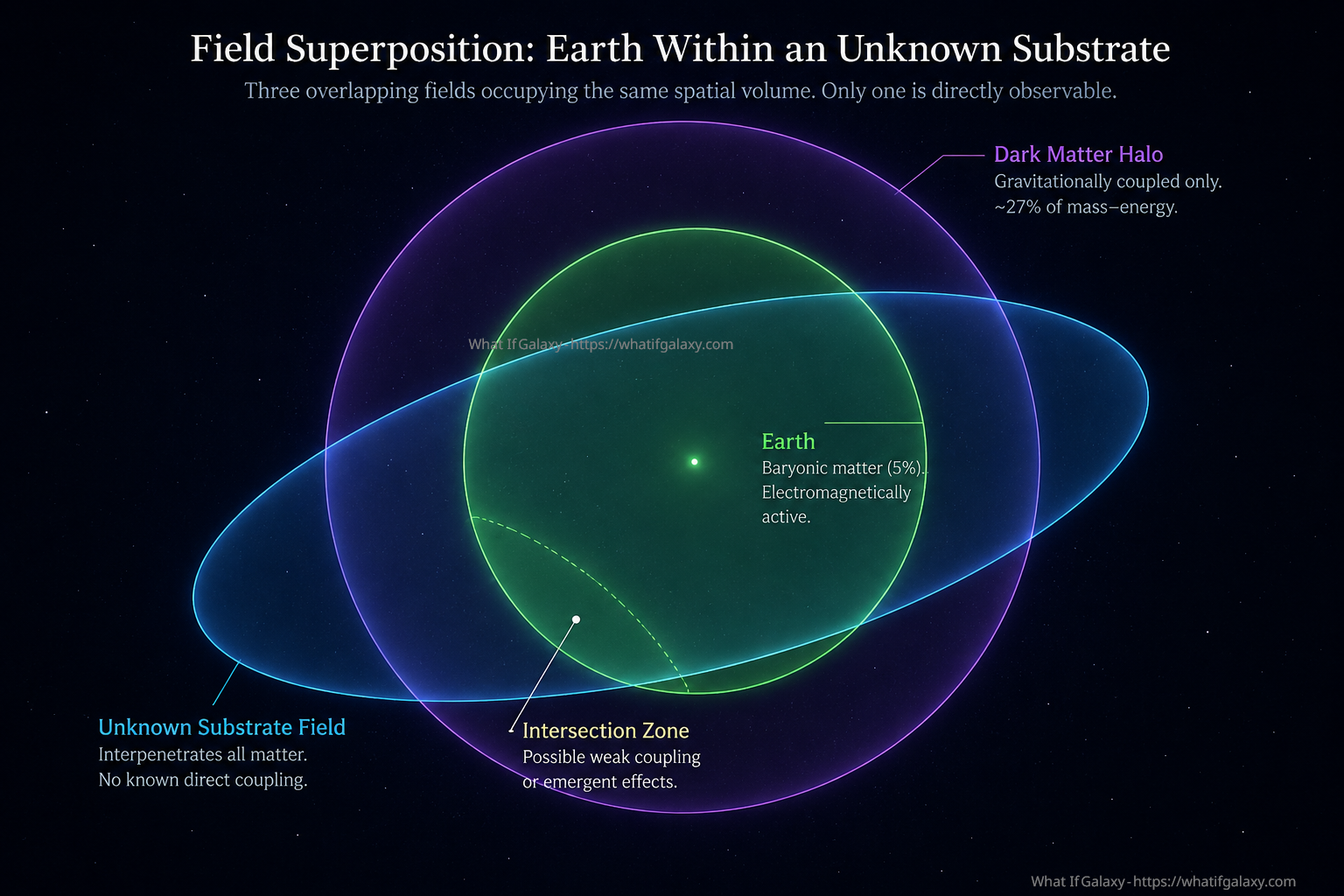
Figure 1 above shows precisely what this section describes. Three phenomena occupy the same spatial volume. The Earth, the dark matter halo, and a third entity whose geometry partially intersects the planet. No arrows of detection run from the third entity to any instrument on Earth. That is the point.
The geometry is not metaphorical. If a phenomenon has an extent, a boundary, and a spatial relationship with the Earth, then the Earth is “inside” it in the same way a fish is inside an ocean. The fish interacts with the water at every surface. But if the ocean were made of neutrinos, the fish would feel nothing, and would have no mechanism to infer its existence. The question becomes: what subtle, cumulative, or anomalous effects might still appear?
What Weak Coupling Would Actually Look Like
If an unknown field or substrate phenomenon interpenetrated Earth and coupled weakly to ordinary matter, the challenge is not merely detection. The challenge is attribution. Because if the coupling is genuinely weak, the individual interaction events would be rare, small in energy, and completely indistinguishable from noise in any single measurement. The only way such a phenomenon would become visible is through statistical accumulation across very large datasets, through patterns that appear across entirely different experimental domains, or through anomalies in precision experiments that resist every known conventional explanation.
This is precisely the situation physicists found themselves in during the early twentieth century with radioactivity. Before 1896, spontaneous particle emission from certain materials was attributed to phosphorescence or chemical reactions. The radiation was real and measurable, but its mechanism was misattributed because the framework for understanding nuclear decay did not exist. The data was present. The interpretation was absent.
Consider, in this light, several categories of anomalies that currently exist in the scientific literature and that resist clean conventional explanation.
The first is the proton radius puzzle. For decades, measurements of the proton’s charge radius from hydrogen spectroscopy and electron-proton scattering converged on approximately 0.877 femtometers. In 2010, a measurement using muonic hydrogen, in which the orbiting electron is replaced by a muon, yielded a value of approximately 0.842 femtometers, a discrepancy of about 4%. This became known as the proton radius puzzle. Subsequent measurements have narrowed but not fully resolved the discrepancy, and the theoretical explanation remains contested. A phenomenon coupling differently to muons than to electrons, even at extremely weak coupling strength, could in principle produce exactly this signature. This is not the favored explanation among physicists, and there are good reasons for that. But it illustrates the category: a precise, reproducible anomaly in a well-characterized system that has no fully settled conventional explanation.
The second is the muon anomalous magnetic moment. The g-2 experiment at Fermilab, which produced updated results in 2023, measured the muon’s magnetic moment to be approximately 0.00000000251 above the Standard Model prediction. The discrepancy has been sustained across multiple experimental runs and multiple facilities. The Standard Model, despite its extraordinary precision, does not predict this value correctly. New particles or fields that couple to muons could account for it. The coupling required is weak but not unmeasurably small. This anomaly has driven substantial theoretical work on what is often called “new physics,” but the nature of that new physics remains entirely open.
The third is a biological anomaly that is discussed far less often in physics circles but is relevant here: the quantum coherence observed in photosynthesis. Experiments published from 2007 onward, particularly work from the Fleming group at UC Berkeley and subsequent replication and extension studies, demonstrated that energy transfer across the light-harvesting antenna complexes of green sulfur bacteria shows quantum coherence signatures lasting hundreds of femtoseconds at room temperature. This was deeply surprising because biological systems are warm and wet, and quantum coherence was expected to decohere almost instantaneously under those conditions. The phenomenon is now referred to in the literature as quantum biology, and it has expanded to include possible quantum effects in avian magnetoreception, enzyme catalysis, and olfaction. The mechanisms are still debated. But the possibility that biological systems, through billions of years of evolutionary pressure, have developed mechanisms that exploit quantum effects too subtle for our instruments to register easily opens a conceptual door. If biology can be sensitive to quantum-level phenomena at room temperature, it is not unreasonable to ask whether biology might be sensitive to other subtle physical couplings whose theoretical basis we have not yet developed.
The Geometry of Partial Crossing
The article’s central image deserves more precise elaboration. The claim is not that a hypothetical unknown phenomenon surrounds the Earth uniformly, the way the atmosphere does, or the way the dark matter halo does. The claim is that such a phenomenon might cross the Earth’s volume partially, the way a river crosses a landscape: entering from one side, passing through, and exiting the other. Or the way the heliopause, the boundary of the sun’s magnetic influence, cuts through the local interstellar medium.
This partial crossing matters for several reasons. If the phenomenon were uniform and isotropic relative to Earth, its effects would be symmetric and thus much harder to detect, since any directional signal would average out. But if the phenomenon has a preferred orientation, a boundary or gradient within the Earth’s volume, then there would be locations on or within the Earth where its effect is stronger, and locations where it is weaker. This would produce spatial gradients in whatever subtle effect it generates.
There is a precedent for thinking about this that is well-established in physics. The Earth moves through the Milky Way’s dark matter halo at approximately 220 kilometers per second. This motion means that from Earth’s reference frame, there is a preferred direction of dark matter flux, the direction of Earth’s galactic velocity, sometimes called the “dark matter wind.” Direct detection experiments such as LUX-ZEPLIN and XENONnT are specifically designed to look for the annual modulation in signal rate that would result from Earth’s changing velocity relative to this flux as it orbits the sun. The DAMA/LIBRA experiment in Gran Sasso has for years reported a statistically significant annual modulation in its signal, though its interpretation remains contested and other experiments have not confirmed the specific dark matter interpretation. The point is that the concept of Earth moving through an ambient non-uniform field, such that different locations or seasons produce different exposure, is already a mainstream experimental framework.
Extend this to the unknown field. If such a phenomenon has spatial structure, if it is not a perfectly uniform substrate but has regions of higher and lower density, or if it has a boundary that partially intersects the Earth, then the Earth’s rotation, orbital motion, and galactic motion would produce a time-varying exposure. Different geological layers, with their different material compositions, might interact with the field differently, producing depth-dependent gradients. The core, the mantle, the crust, and the surface biosphere would each present a different interaction cross-section, not unlike the way different materials have different refractive indices for electromagnetic radiation.
This is the image: not a uniform bath, but a crossing, an interpenetration with internal structure, producing gradients that are in principle measurable if one knew what to measure.
What Biology Might Be Telling Us Without Language
There is a long tradition in the history of science of treating biology as a receiver. The magnetic sense of migratory birds depends on magnetite crystals in the beak region and on cryptochrome proteins in the retina that are sensitive to the Earth’s magnetic field. The lateral line system of fish detects pressure waves and electric field gradients in water that no human sensory system registers. Electroreception in sharks, the platypus, and several species of electric fish enables the detection of electric fields as weak as five nanovolts per centimeter, far below any threshold detectable by human skin. Pit organs in certain snakes detect infrared radiation in frequency ranges outside human visual sensitivity.
The consistent lesson from comparative sensory biology is that the range of physical phenomena for which biological transduction mechanisms exist is much broader than the range to which humans are sensitive. Evolution produces sensory systems when the information they provide has survival value. In environments where a relevant physical phenomenon exists, selection pressure over millions of years tends to produce detection mechanisms.
The inverse of this principle is equally interesting. If a physical phenomenon has been present throughout evolutionary history but has never provided meaningful differential fitness information, no dedicated transduction mechanism would evolve. Not because the phenomenon does not interact with biology, but because the interaction never produced information that distinguished reproductively successful from unsuccessful individuals. A phenomenon that affects all organisms identically, regardless of behavior, would leave no evolutionary fingerprint in the form of a dedicated sense.
This means absence of a sensory system is not evidence of absence of the phenomenon. It is only evidence that the phenomenon did not historically generate fitness-relevant differential information. An unknown field interpenetrating the Earth uniformly would leave no sensory trace in any organism, not because it does not interact with biological tissue, but because it interacts with all biological tissue equally and thus generates no actionable information for individual organisms.
Where things become more interesting is in the possibility of indirect biological effects. If an unknown field coupled weakly to biochemical systems, it might modulate reaction rates, alter protein folding kinetics, or influence membrane transport at levels that are subthreshold for any single measurement but statistically significant across large populations and long time periods. It might contribute to variation in physiological baselines that we currently attribute entirely to genetic and environmental factors. The signal-to-noise ratio would be deeply unfavorable for any single experiment. But epidemiological data across millions of individuals, analyzed for spatial and temporal correlations that track the hypothetical field’s geometry, might in principle reveal systematic patterns.
This is not a claim that biology is currently showing evidence of an unknown field. It is a methodological observation: if such a thing existed, the biological signal would be weak, spatially patterned, temporally modulated, and deeply embedded in variance that would require very large datasets and novel analytical frameworks to extract.
Instrumentation and the Problem of Conceptual Precommitment
The history of failed detection is as instructive as the history of successful discovery. When physicists searched for the luminiferous aether, the hypothetical medium through which light was presumed to propagate, the Michelson-Morley experiment of 1887 produced a null result. The aether did not exist. But the reason the null result was so useful was that the experimental design was precisely matched to what the aether, if it existed, would produce. The experiment looked for the right thing in the right way and found nothing.
The deeper problem with an entirely unconceptualized phenomenon is that we do not yet know what to look for, which means we cannot design the right experiment. Every instrument currently operational is looking for interactions mediated by the known forces. The LHC searches for particles that couple to the Standard Model fields. LIGO searches for gravitational wave strain in spacetime. Neutrino detectors look for weak-force interactions in massive tanks of water or ice. Even the most exotic searches, for axions, for sterile neutrinos, for magnetic monopoles, are searches for specific theoretical objects whose properties are specified in advance by theoretical models.
A phenomenon that lies outside our current theoretical vocabulary would not necessarily produce a signal in any of these instruments. It might produce a signal in an instrument designed for something else, registered as anomalous noise, and discarded because it does not match the expected pattern of any known effect.
This is not a new problem in physics. The history of serendipitous discovery, from X-rays (discovered by Roentgen in 1895 while investigating cathode ray tubes) to cosmic microwave background radiation (discovered by Penzias and Wilson in 1965 while troubleshooting a microwave antenna used for satellite communication) to pulsars (discovered by Jocelyn Bell Burnell in 1967 as a regular radio pulse dismissed initially as radio frequency interference), is populated with cases in which phenomena were initially registered as noise or artifact precisely because they did not match the theoretical template the experimenter was using.
The systematic implication is significant. If an unknown phenomenon produces faint signals in existing instruments, those signals are being actively filtered out in data analysis pipelines. Anomaly rejection algorithms, designed to eliminate noise, are not distinguishing between noise and a genuine unrecognized signal. They are eliminating both. The phenomenon would need to be either strong enough to survive filtering, or it would need to produce a pattern systematic enough to be recognized as non-random even after filtering.
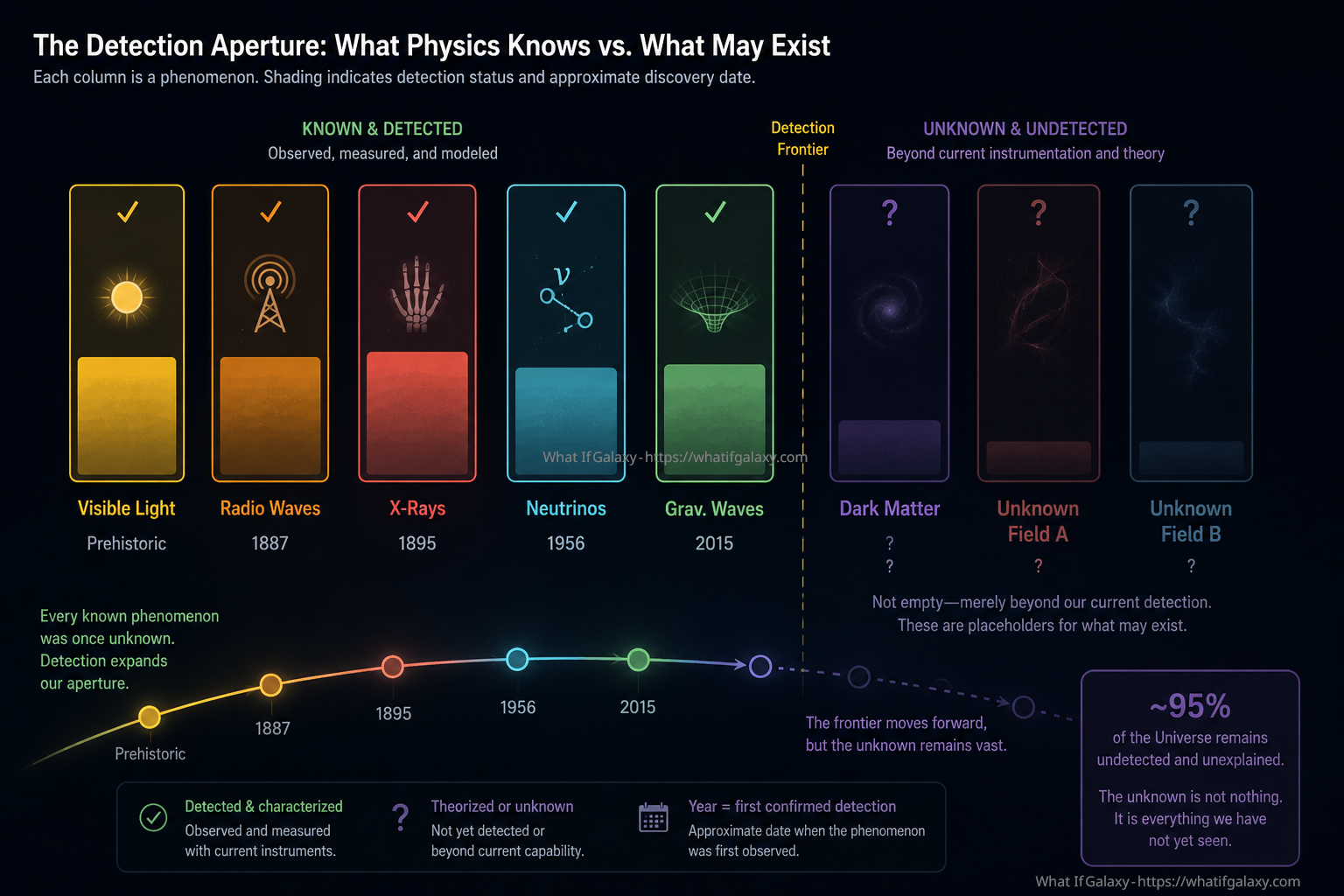
Figure 2 renders the historical arc. Every phenomenon now firmly in the left half of that diagram spent time in the right half, invisible and unconceptualized. The right half is not empty space in the diagram. It is full of things. We simply do not know what they are, which is why the bars are faint rather than absent.
The Question of Naming and Conceptual Frameworks
One of the underappreciated difficulties in speculation about truly novel phenomena is linguistic. The moment one reaches for an analogy, “it is like a field,” “it is like a wave,” “it behaves like a fluid,” one is importing conceptual baggage from the known. Every existing physics concept was developed to describe something already observed. A wave is a concept derived from water surfaces and later extended to sound, to light, to probability amplitudes in quantum mechanics. A field is a concept extended from the gravitational and electromagnetic cases to the nuclear forces and then to quantum fields. The mathematics of these extensions works because the underlying structure has enough in common with the original case to make the abstraction valid.
For a truly novel category of phenomena, the problem is more fundamental. Not only do we lack the instruments, we lack the words, and more than the words, we lack the mathematical objects. General relativity required Riemannian geometry, which had been developed by mathematicians decades before Einstein used it, not for physics, but for abstract reasons of mathematical interest. Quantum mechanics required Hilbert spaces, linear operators, and probability theory synthesized in a way no physicist had previously combined. Quantum field theory required an entirely new approach to the renormalization of divergent integrals that took decades to work out rigorously.
The implication is sobering and exciting in equal measure. If an unknown phenomenon exists and is genuinely outside our current conceptual vocabulary, it is possible that the mathematics needed to describe it has already been developed by pure mathematicians working without physical motivation, just as Riemann’s geometry preceded Einstein. Topology, category theory, and higher-dimensional geometric algebra all contain structures that have not yet found physical application. It is possible that the framework for the unknown phenomenon is already written down in some mathematics paper and that we simply have not made the connection.
Alternatively, the phenomenon may require mathematics that does not yet exist. This would not be unprecedented. The phenomena of quantum mechanics could not have been correctly described using mathematics available in 1800. The description required 125 years of mathematical development. A phenomenon more structurally alien than quantum mechanics might require a comparably long mathematical gestation.
Signatures in the Anomaly Catalogue
If one surveys the current scientific literature with attention to anomalies, measurements that deviate from Standard Model predictions at statistical significance levels that preclude simple dismissal but resist clean conventional explanation, a list emerges that is worth examining in the context of this article’s central speculation.
The Hubble tension is among the most significant. The rate of expansion of the universe, the Hubble constant, can be measured in two independent ways: from the cosmic microwave background radiation using Planck satellite data, which gives a value of approximately 67.4 kilometers per second per megaparsec, and from local measurements using Cepheid variable stars and Type Ia supernovae as distance ladders, which consistently give values in the range of 73 kilometers per second per megaparsec. The discrepancy is approximately 9%, far beyond measurement uncertainty, and it has persisted and intensified as both measurement methods have been refined. As of 2025, the tension is at roughly the 5-sigma level, which in particle physics would constitute a discovery. A new form of energy density, new interaction during the early universe, or a modification of gravity at cosmological scales have all been proposed. None has been confirmed. The possibility that an unknown substrate-level phenomenon contributes to energy density in a way that scales differently with cosmic expansion than known forms of energy is speculative, but it is not more speculative than several of the published proposed solutions.
The fast radio burst origin problem is a second anomaly worth noting. Fast radio bursts are millisecond-duration radio transients of extragalactic origin, first detected in 2007. As of 2026, thousands have been catalogued, approximately 50 of which are repeating sources. Their origin mechanisms remain debated, with magnetars as the leading candidate following the first Milky Way fast radio burst detected from the magnetar SGR 1935+2154 in 2020. However, the full population statistics of fast radio bursts, particularly their distribution across redshifts and their dispersion measure-redshift relationship, contain features that have not been fully reconciled with any single source model. Whether an unknown propagation effect, possibly mediated by a field not accounted for in standard cosmology, contributes to fast radio burst observational properties is genuinely open.
The anomalous excess heat in certain condensed matter systems, studied under the umbrella of what was controversially called cold fusion and is now more carefully labeled low-energy nuclear reactions, remains a contested and poorly understood phenomenon. While the original Fleischmann-Pons claims were not reproducible in the claimed form, subsequent carefully controlled experiments by groups including those at the Naval Research Laboratory, MIT, and in Japan have produced anomalous heat signatures in palladium-deuterium systems that resist explanation by conventional nuclear cross-sections at low energies. The phenomenon is not proven, and its status in mainstream physics is contested. But the data has not been fully explained away, and the possibility that some unknown field interaction contributes to nuclear reaction rates in certain material configurations under specific conditions has not been rigorously excluded.
These anomalies are listed not to suggest that they are all caused by the same unknown phenomenon, but to illustrate that the scientific literature in 2026 is not anomaly-free. The Standard Model is not a complete and closed book. There are pages that do not fit.
Temporal Signatures: The Annual and Diurnal Modulation Argument
One of the most powerful methodological strategies for detecting a spatially non-uniform field that Earth moves through is to look for temporal modulation in precision measurements correlated with Earth’s motion. This strategy is already deployed in dark matter direct detection, as described earlier, but it generalizes significantly.
Earth rotates once per day, producing a diurnal modulation in the direction any fixed-frame field presents to a point on the surface. Earth orbits the sun once per year, producing an annual modulation in the velocity vector relative to any galactic-frame field. The solar system orbits the galaxy approximately once every 225 to 250 million years, the galactic year, producing a modulation on geological timescales. Earth also bobs above and below the galactic plane over a period of approximately 64 million years as it follows the sun through the galaxy’s gravitational potential.
This last timescale is geologically interesting. The period of 64 million years corresponds approximately, with significant uncertainty, to several proposed cycles in Earth’s geological and biological record: periodic increases in impact cratering rate, proposed periodicity in large igneous provinces, and the famous and still-debated proposal by Raup and Sepkoski in 1984 of a 26-million-year periodicity in mass extinctions. The numbers do not perfectly agree and the statistical significance of the proposed periodicities is contested. But the conceptual point is clear: a field with structure at galactic scales, through which Earth periodically moves into regions of higher or lower density, would produce biological and geological effects with periods determined by orbital mechanics. Looking for patterns in the geological and paleontological record at periods corresponding to orbital timescales is therefore a principled scientific strategy for finding indirect evidence of a large-scale non-uniform field, whatever its nature.
This is not fringe speculation. The study of solar system motion through the galactic environment and its potential influence on Earth’s geological and biological history is an active research area in astrobiology and geophysics. The connection to an unknown field is speculative, but it sits in a methodological neighborhood that is scientifically serious.
Could Consciousness Be A Receiver?
This section addresses what is perhaps the most charged and difficult dimension of the central speculation, charged not because it is necessarily incorrect but because it occupies territory where genuine scientific inquiry and wishful thinking have historically been very poorly distinguished.
The hard problem of consciousness, David Chalmers’ formulation of the question of why physical processes give rise to subjective experience, remains genuinely unsolved. The neural correlates of consciousness have been mapped with increasing precision: we know a great deal about which brain regions are active during various states of awareness, which neurotransmitters mediate attention and altered states, which lesions produce which deficits in conscious experience. But the explanatory gap between third-person descriptions of neural activity and first-person subjective experience has not been bridged by any current theory.
Several serious theoretical physicists have speculated, carefully, that this explanatory gap might indicate that consciousness involves, or is sensitive to, physical processes not fully captured by standard neuroscience. Roger Penrose, in collaboration with anesthesiologist Stuart Hameroff, proposed in the 1990s that quantum processes in microtubules within neurons, a framework they called Orchestrated Objective Reduction (Orch-OR), might be relevant to conscious experience. The theory remains controversial and faces significant objections from biologists who doubt that quantum coherence can be maintained in the warm, wet environment of a neuron. But Penrose’s underlying motivation, that the non-computational aspects of conscious experience resist purely classical explanation, is taken seriously by a subset of theoretical physicists.
If consciousness involves sensitivity to subtle physical fields at a level that classical neuroscience does not fully capture, then it becomes at least conceivable that an unknown field interpenetrating biological tissue might interact with whatever physical substrate underlies conscious experience. This would not necessarily mean that conscious experience “detects” the field in any actionable way. The interaction might be subtle, contributing to baseline variations in cognitive function, in states of altered awareness, in the phenomenology of dreams or meditation, in ways that are systematically correlated with exposure to the hypothetical field without any individual ever recognizing the correlation.
The methodological challenge here is severe. The signal-to-noise problem in consciousness research is already acute under conventional assumptions. Adding an unmeasured and uncharacterized variable makes the analysis intractable with current tools. But it is worth noting that many of the most striking phenomena in human cognitive psychology, the systematic patterns in placebo response, the documented but poorly understood effects of geomagnetic activity on mood and sleep quality, the persistent unexplained variance in psychophysical measurements, represent exactly the kind of weak spatially and temporally patterned signal that an interaction with an unknown field might produce.
This is not an endorsement of parapsychology or any specific claim about consciousness and hidden fields. It is an observation that the scientific study of consciousness already contains a methodological gap large enough that a weak coupling to an unknown field could be hiding within the existing variance, undetected.
What a Detection Protocol Might Look Like
If forced to design a preliminary detection strategy for a phenomenon fitting the description developed in this article, without knowing its nature but assuming the general properties described here, what would that strategy look like?
First, it would require correlational analysis across entirely different measurement domains simultaneously. If an unknown field produces weak coupling across multiple physical systems, its signature should appear as a correlated anomaly in measurements that are otherwise independent. Anomalies in condensed matter behavior, in biological baseline measurements, in precision atomic clocks, and in geodetic measurements should show correlated temporal variation if they share a common cause. Looking for cross-domain correlations at the same temporal frequencies, diurnal, annual, and longer-period, is a strategy that does not require knowing the nature of the phenomenon in advance.
Second, it would require a global array of ultra-sensitive multi-modal detectors, designed not to look for a specific particle or interaction but to record everything at the highest possible precision and then perform data archaeology. This is conceptually similar to what pulsar timing arrays do for gravitational waves: they use the timing residuals of millisecond pulsars across the galaxy as an enormous gravitational wave detector, not by building a physical instrument but by treating the existing pulsar population as a natural sensor array. The analogy would be to treat the global network of seismometers, magnetometers, precision clocks, and atmospheric chemistry monitors as a coincidental sensor array and to mine their combined datasets for correlated anomalies at physically motivated frequencies.
Third, it would require theoretical courage: the willingness to take anomalies seriously without immediately forcing them into existing categories, and to invest in the development of new mathematical frameworks before knowing what phenomenon they will eventually describe. This is the aspect least amenable to institutional science as currently structured, since funding bodies require well-specified hypotheses and measurable outcomes. But the history of science shows that the most conceptually revolutionary advances have come from exactly this kind of unmotivated theoretical development, Riemann’s geometry being the canonical example.
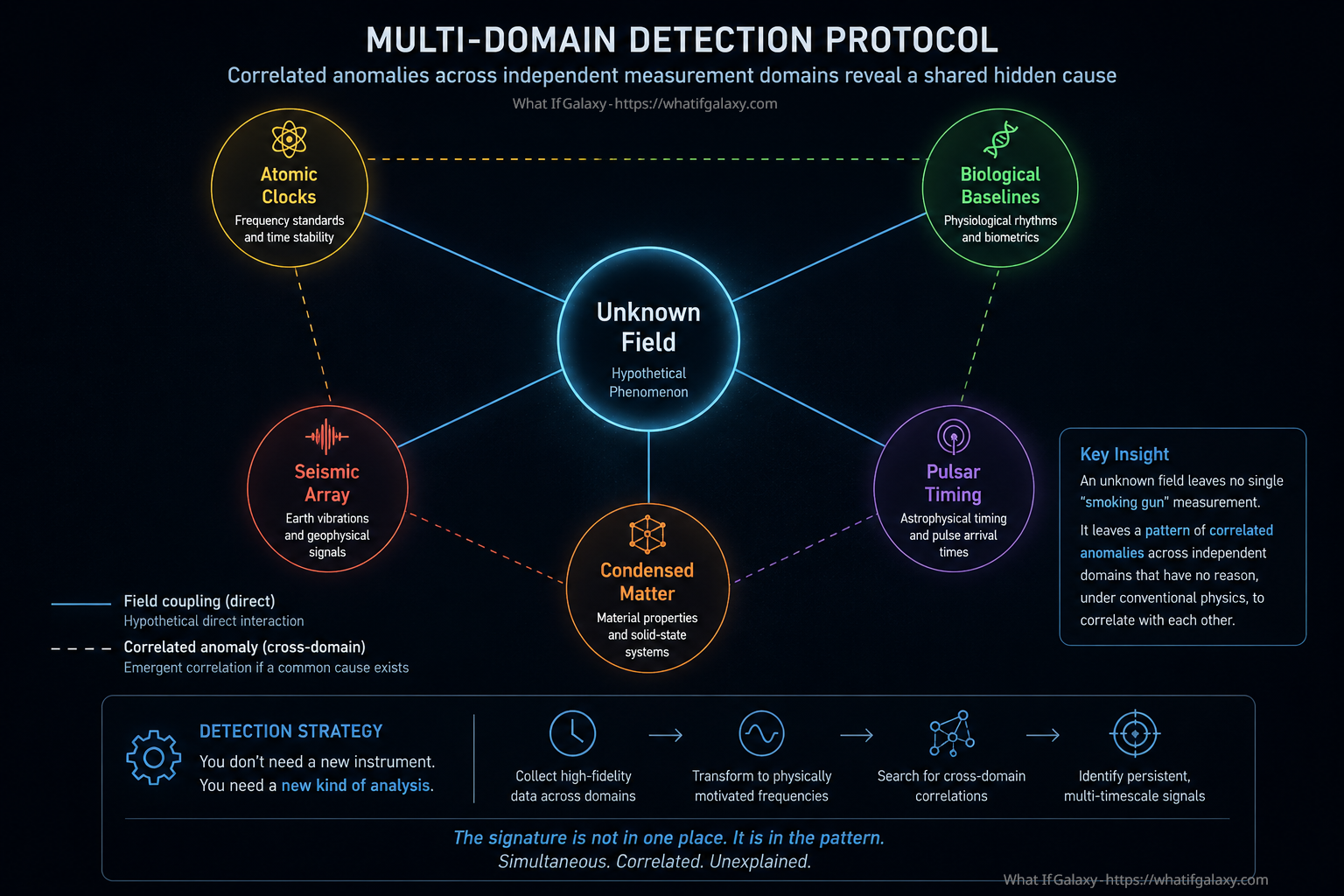
Figure 3 encodes the core methodological insight. An unknown field leaves no single “smoking gun” measurement. What it leaves is a pattern of correlated anomalies distributed across measurement domains that have no reason, under conventional physics, to correlate with each other. The detection strategy does not require building a new instrument. It requires building a new kind of analysis: cross-domain, multi-timescale, anomaly-correlation at physically motivated frequencies.
The Ethical and Epistemological Dimensions
Before concluding the main body of this article, it is worth pausing on two dimensions of the central speculation that do not receive enough attention in similar discussions.
The first is epistemological. There is a risk, when speculating about unknown phenomena, of constructing a framework so flexible that it can accommodate any observation. An unknown field that interpenetrates matter and interacts weakly with everything is, in its most underspecified form, an unfalsifiable hypothesis. For a speculation to be scientifically interesting rather than merely imaginatively entertaining, it needs to make predictions that can in principle be tested and that could in principle fail. The detection strategy outlined in the previous section does provide falsifiable predictions: it predicts that if an unknown field of the described type exists, correlated anomalies across independent measurement domains should appear at physically motivated temporal frequencies. If intensive cross-domain analysis of global sensor network data at diurnal, annual, and longer periodicities reveals no correlated anomalies beyond what conventional physics predicts, that is genuine evidence against the hypothesis. The hypothesis is falsifiable, which is the minimum condition for scientific legitimacy.
The second dimension is ethical and concerns the relationship between legitimate speculative science and the ecosystem of pseudoscientific claims that borrows the language of physics without its discipline. Terms like “energy fields,” “vibrations,” “frequencies,” and “quantum effects” have been appropriated wholesale by wellness culture, alternative medicine, and various forms of magical thinking in ways that are disconnected from any physical measurement or theoretical framework. The central speculation of this article is not in that category, but it shares enough surface vocabulary with it that the distinction must be explicit. What separates this article from pseudoscience is not subject matter but methodology: the commitment to falsifiability, the grounding in existing physics, the explicit acknowledgment of what is known versus what is speculated, and the refusal to make specific claims about effects that are not supported by evidence.
An unknown field interacting with biological systems is a scientifically legitimate speculation when it is grounded in the actual incompleteness of the Standard Model, when it is constrained by the known properties of physical interactions, and when it makes predictions that future data could test. It is pseudoscience when it is used to explain specific health claims, when it is invoked to validate practices without evidence, and when it is made unfalsifiable by constant post-hoc adjustment to fit any observation. This article is in the first category. The distinction matters.
A Universe That Has Not Finished Introducing Itself
History keeps the same appointment, again and again. The universe contains more structure than any given era’s instruments or concepts can resolve, and it reveals its inventory not according to human impatience but according to the slow accumulation of technological and theoretical capability. Each generation of physicists has lived inside a version of the Standard Model that felt nearly complete and was not. Maxwell’s contemporaries believed that classical physics was essentially finished; only a few troubling anomalies remained, including the ultraviolet catastrophe and the photoelectric effect, both of which turned out to be symptoms of quantum mechanics. Physicists in the 1970s, with the Standard Model newly assembled, believed the inventory of fundamental particles was nearly complete; the Higgs boson and the top quark were still missing. In 2026, the Standard Model accounts for approximately 5% of the universe’s mass-energy content, and multiple precision anomalies remain unresolved.
We are inside a between-time. The instruments of the twenty-first century are extraordinarily powerful by any historical comparison, and yet the universe’s 95% unexplained content sits there, present in every cubic meter of space, passing through every measurement we take, shaped by dynamics we cannot yet describe. It would be remarkable, given this history, if the 95% contained only the two categories we have already named: dark matter and dark energy. It would be more consistent with history if it contained a richer inventory, including phenomena that do not fit either of those categories, that interpenetrate ordinary matter without triggering our instruments, and that we are interacting with in every moment of every day without any awareness whatsoever.
The Earth is superimposed on something. Perhaps many somethings. It moves through them, rotates within them, carries its biosphere through them over geological timescales. Some of those somethings we have named. The dark matter halo is real. Gravitational waves are real and continuous. The electromagnetic radiation bath from the cosmic microwave background is real. But the list is almost certainly not complete. The universe has not finished introducing itself, and the next introduction may require instruments we have not built, mathematics we have not written, and concepts that no human mind has yet formed.
That is not cause for anxiety. It is the most interesting fact about the present moment in the history of science.
References
- Hertz, H. Electric Waves. Macmillan, 1893.
- Cowan, C.L., Reines, F., Harrison, F.B., Kruse, H.W., McGuire, A.D. Detection of the Free Neutrino: A Confirmation. Science, 1956.
- Abbott, B.P. et al. (LIGO Scientific Collaboration and Virgo Collaboration). Observation of Gravitational Waves from a Binary Black Hole Merger. Physical Review Letters, 2016.
- Particle Data Group. Review of Particle Physics. Progress of Theoretical and Experimental Physics, 2022.
- Planck Collaboration. Planck 2018 Results. Astronomy and Astrophysics, 2020.
- Pohl, R. et al. The size of the proton. Nature, 2010.
- Abi, B. et al. (Muon g-2 Collaboration). Measurement of the Positive Muon Anomalous Magnetic Moment to 0.46 ppm. Physical Review Letters, 2021.
- Muon g-2 Collaboration. Further improved measurement of the anomalous magnetic moment of the muon. Physical Review Letters, 2023.
- Engel, G.S. et al. Evidence for wavelike energy transfer through quantum coherence in photosynthetic systems. Nature, 2007.
- Ritz, T., Adem, S., Schulten, K. A model for photoreceptor-based magnetoreception in birds. Biophysical Journal, 2000.
- Riess, A.G. et al. A Comprehensive Measurement of the Local Value of the Hubble Constant with 1 km/s/Mpc Uncertainty. Astrophysical Journal Letters, 2022.
- Verde, L., Treu, T., Riess, A.G. Tensions between the Early and the Late Universe. Nature Astronomy, 2019.
- CHIME/FRB Collaboration. The first CHIME/FRB Fast Radio Burst Catalogue. Astrophysical Journal Supplement Series, 2021.
- Scholz, P. et al. A Bright Millisecond-Duration Radio Transient from a Galactic Magnetar. Nature, 2020.
- Storms, E. The Science of Low Energy Nuclear Reaction. World Scientific, 2007.
- Penrose, R. The Emperor’s New Mind. Oxford University Press, 1989.
- Hameroff, S., Penrose, R. Orchestrated Objective Reduction of Quantum Coherence in Brain Microtubules. Mathematics and Computers in Simulation, 1996.
- Raup, D.M., Sepkoski, J.J. Periodicity of Extinctions in the Geologic Past. Proceedings of the National Academy of Sciences, 1984.
- Svensmark, H., Friis-Christensen, E. Variation of cosmic ray flux and global cloud coverage. Journal of Atmospheric and Solar-Terrestrial Physics, 1997.
- Michelson, A.A., Morley, E.W. On the Relative Motion of the Earth and the Luminiferous Ether. American Journal of Science, 1887.
- Penzias, A.A., Wilson, R.W. A Measurement of Excess Antenna Temperature at 4080 Mc/s. Astrophysical Journal, 1965.
- Hewish, A., Bell, S.J., Pilkington, J.D.H., Scott, P.F., Collins, R.A. Observation of a Rapidly Pulsating Radio Source. Nature, 1968.
- Aprile, E. et al. (XENON Collaboration). First Dark Matter Search Results from the XENONnT Experiment. Physical Review Letters, 2023.
- Chalmers, D.J. The Conscious Mind: In Search of a Fundamental Theory. Oxford University Press, 1996.
- Penrose, R. The Road to Reality. Jonathan Cape, 2004.