
What If All Life on Earth Arrived from Another Planet We Were Forced to Leave
The Question That Rewrites Everything
Picture the scene not as science fiction, but as science possibility: a biosphere in its final hours. A planet, perhaps orbiting a star a few dozen light-years from our Sun, cradles an entire web of life. Forests breath and photosynthesize. Oceans teem with creatures of staggering diversity. Somewhere in those oceans, or in the mineral-rich mud of hydrothermal vents, something resembling our earliest microbial ancestors pulses with chemistry. And then, the end comes. Perhaps a supernova irradiates the system. Perhaps a planetary collision tears the world apart. Perhaps a runaway greenhouse effect turns its oceans to vapor. The biosphere has decades or centuries, at most, to find a way out.
What if it did? What if, millions or even billions of years ago, some fraction of life on that dying world survived the catastrophe? Not by evolving quickly enough, not by hiding in deep rock, but by leaving entirely, crossing interstellar space, and landing on a young, receptive world called Earth?
This is not the premise of a novel. It is a scientifically coherent hypothesis with a name, a literature, and, as of 2024 and 2025, a growing body of circumstantial evidence that makes it harder to dismiss than at any previous point in human history. The question “What if all life on Earth came from another planet?” sits precisely at the intersection of panspermia theory, planetary catastrophe science, astrochemistry, and the fastest-moving field in modern biology: the genomics of extremophile organisms. To ask it seriously is to discover that the boundary between wild speculation and legitimate science is thinner than we assumed.
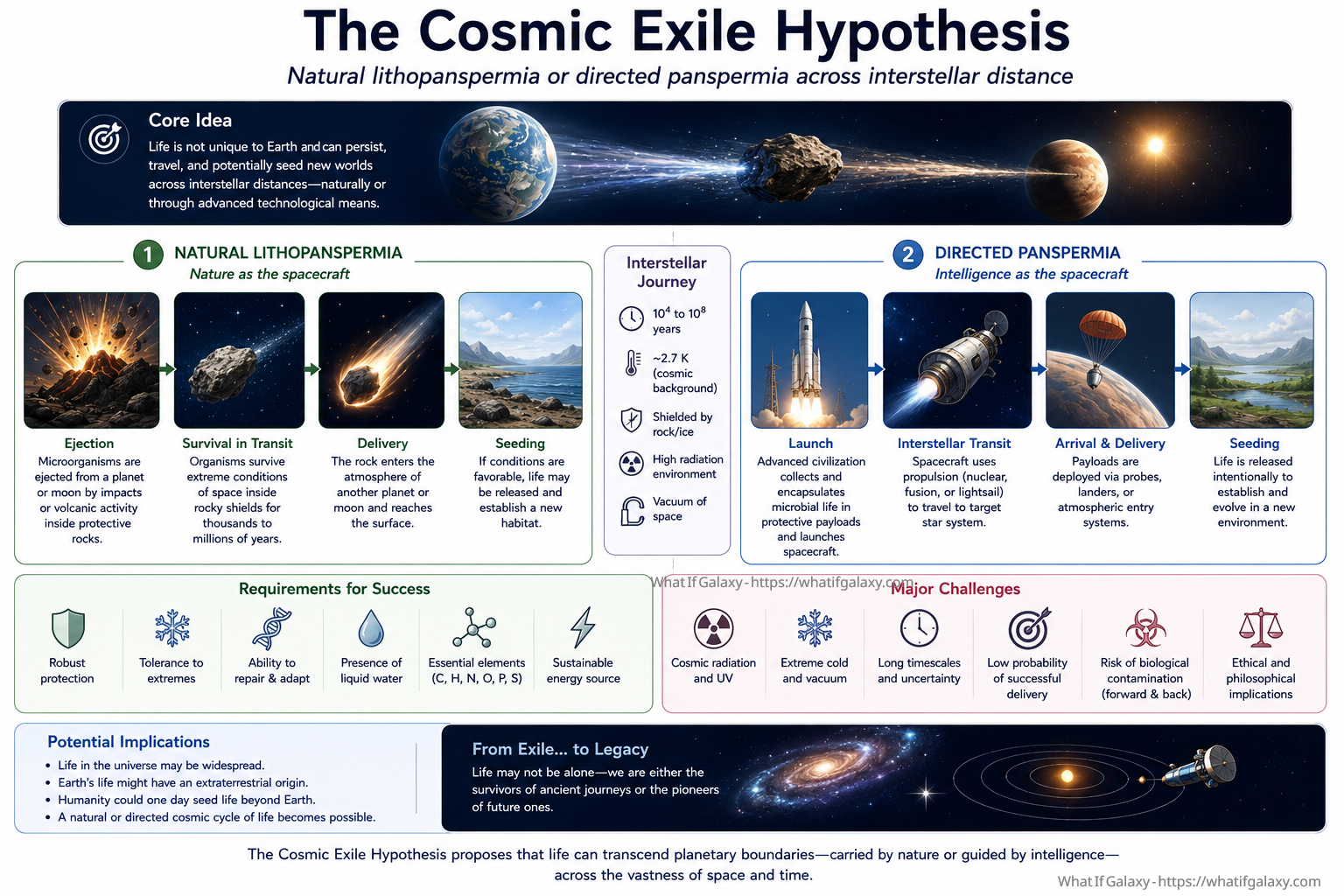
The five-stage journey of life from a dying planet to early Earth, from catastrophe and ejection, through interstellar transit in cryptobiosis, to arrival and the emergence of LUCA. Illustration: WhatIfGalaxy
What Science Already Knows, and What It Keeps Finding
Before the speculation can earn its credibility, the foundations must be examined. And those foundations, as of 2026, are considerably more solid than popular accounts suggest.
The Last Universal Common Ancestor and the Puzzle of Its Timing
All known life on Earth shares a common ancestor. This is not a contested point. Every organism that has ever lived on this planet, from the bacterium colonising your gut to the blue whale and the redwood tree, traces its lineage back to a single ancestral population of cells. Scientists call this entity LUCA: the Last Universal Common Ancestor. For decades, estimating LUCA’s age was a matter of fossil calibration and guesswork, and estimates ranged broadly. That uncertainty narrowed dramatically in July 2024.
A landmark study published in Nature Ecology and Evolution, led by Edmund Moody and colleagues at the University of Bristol, used a newly refined method of analysing gene families that were duplicated before LUCA diverged into the bacterial and archaeal domains. By calibrating these duplications against microbial fossil records and isotope data using what the team called a “cross-bracing” implementation of divergence-time analysis, they arrived at a figure: LUCA lived approximately 4.2 billion years ago, with a confidence interval of 4.09 to 4.33 billion years.
The implications are profound, and not merely because the number is old. The Moon-forming impact, the catastrophic collision with a Mars-sized body that created Earth’s satellite and likely sterilised or severely disrupted the planet’s surface, occurred approximately 4.5 billion years ago. The first geochemically plausible conditions for stable liquid water on Earth’s surface are estimated to have emerged around 4.3 to 4.4 billion years ago. LUCA, at 4.2 billion years old, therefore appears to have arisen within a geological window of only 100 to 200 million years after those first habitable conditions formed.
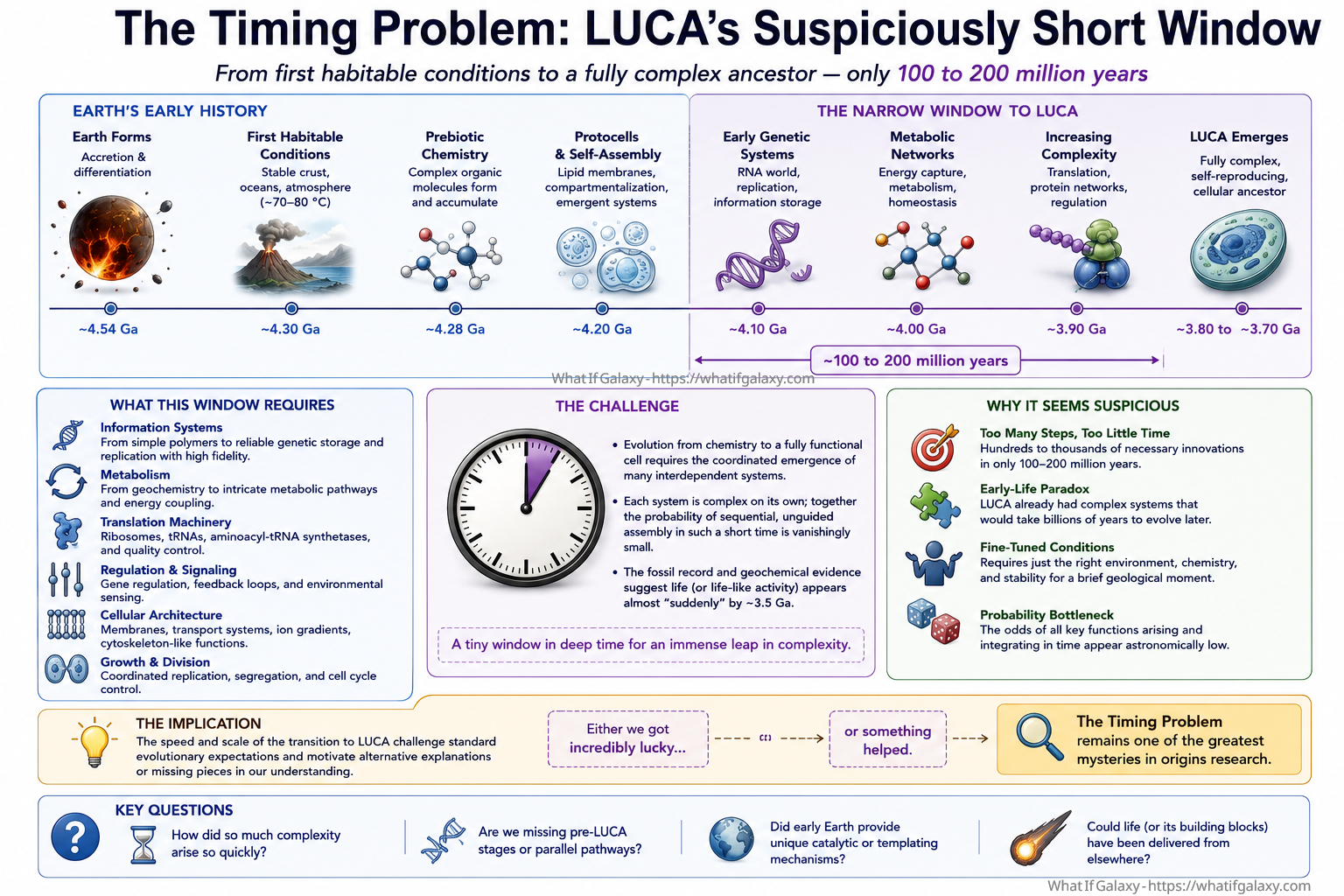
From first habitable conditions on Earth to a fully complex Last Universal Common Ancestor, the window is alarmingly narrow. Source: Moody et al., Nature Ecology and Evolution, 2024
One hundred to two hundred million years sounds like a long time. For the origin of life from raw chemistry, it is barely a heartbeat. The spontaneous emergence of a genome 2.5 megabases long, encoding roughly 2,600 proteins, possessing an already-functioning immune system sophisticated enough to wage war against viruses, is precisely the kind of result that, as Moody’s team noted, “suggests that life was already flourishing in a pre-existing ecosystem.” A pre-existing ecosystem implies predecessors. Predecessors, on a planet that may not yet have had the time to generate them spontaneously, raise an uncomfortable but undeniable question: where did they come from?
The timing does not prove panspermia. But it creates a genuine scientific puzzle whose solution demands serious engagement with the possibility that LUCA arrived on Earth already assembled, already ancient, already battle-tested by a long evolutionary history elsewhere.
The Martian Meteorite That Didn’t Kill Anything
Lithopanspermia, the hypothesis that microorganisms can survive interplanetary transfer inside rocks, is the most experimentally grounded variant of panspermia theory. It rests on a documented mechanism. Planetary impacts eject surface material at velocities sufficient to escape a planet’s gravity well. That material travels through space. Sometimes it lands elsewhere. We know this happens. Hundreds of Martian meteorites have been recovered on Earth, among them the famous Allan Hills 84001, which made headlines in 1996 for its controversial putative microfossils.
The critical detail about ALH 84001 is not the fossils, which remain disputed. It is the temperature record. Analysis of the minerals within the rock indicates it was never heated above approximately 40 degrees Celsius during its journey from Mars to Earth. Living bacterial endospores survive at those temperatures with ease. The transfer mechanism is not hypothetical; it is documented physics. What remains unproven is whether any actual organisms have ever made such a journey alive. But the physical envelope for survival is real, and it is large enough to matter.
More recently, a paper published in PLOS Pathogens in March 2025 by Frederic Bushman of the University of Pennsylvania’s Perelman School of Medicine extended the question to viruses, coining the term “virolithopanspermia” and noting that viral particles embedded within rock matrices might survive the harsh conditions of interplanetary or even interstellar transfer. The paper is speculative, but its speculations are grounded in virology, astrophysics, and the established physical properties of meteoritic shielding.
In January 2026, a detailed essay in Aeon brought the theory of panspermia into its most recent interdisciplinary context, situating it against the findings of the Europa Clipper mission, the Cassini data on Enceladus, and the mounting evidence that liquid water, the universal solvent of known biochemistry, exists in multiple locations in our solar system alone. If liquid water is common and microbial life is hardy enough to travel in rock, the universe begins to look less like an empty stage and more like a network.
Tardigrades and the Evidence That Life Is Hardier Than We Imagined
No organism has done more to rehabilitate the plausibility of interplanetary biology than the tardigrade. These microscopic animals, known colloquially as water bears or moss piglets, routinely survive conditions that would obliterate any other multicellular life: temperatures ranging from near absolute zero to 150 degrees Celsius, pressures six times greater than the deepest ocean trenches, complete desiccation for years, and direct exposure to ionising radiation at doses hundreds of times lethal to humans.
What makes tardigrades scientifically interesting in this context is not merely that they survive, but how. Research published in eLife in July 2024 by Jean-Paul Concordet, Anne de Cian, and colleagues at the Museum National d’Histoire Naturelle in Paris revealed that tardigrades do not prevent DNA damage from ionising radiation. They accumulate the same degree of double-strand DNA breaks as organisms that cannot survive such exposure. What they do differently is repair that damage, with extraordinary speed and efficiency, using a unique tardigrade-specific DNA-binding protein the team designated TDR1. The gene encoding TDR1 was subsequently introduced into human cells, which then demonstrated significantly enhanced radiation tolerance.
This matters for panspermia in two ways. First, it demonstrates that mechanisms for surviving extreme radiation exposure have actually evolved, and can be identified and studied at the molecular level. Second, a paper published in Science in October 2024 by Chinese researchers analysing a newly discovered tardigrade species, Hypsibius henanensis, found that upon exposure to lethal gamma radiation doses, the animals activated 2,801 genes involved in DNA repair, immune response, and cellular defence. Among these was a gene designated DODA1, acquired through horizontal gene transfer from bacteria millions of years ago, which produces the antioxidant betalain as a radiation shield. The presence of bacterially-derived genes in tardigrade DNA is itself a detail worth pausing on: tardigrades carry genetic material that originated in another kind of organism, integrated seamlessly into their own biology. Horizontal gene transfer, the process by which genetic material crosses species boundaries, is considered by many astrobiologists to be one of the mechanisms by which a seeding event could distribute functional biological innovation across a biosphere.
The deeper point is this: the tardigrade exists. It is real, it is on Earth right now, and it can survive the vacuum and radiation of space. If such organisms evolved here, they could in principle survive interplanetary or interstellar transit. If something like them evolved elsewhere, they could have made the trip to Earth.
Building the Scenario: A World Ends, and Life Escapes
With the scientific groundwork in place, the speculative architecture of the central premise can now be constructed with discipline. The question is not merely whether life could arrive from space, but whether an entire biosphere, or a significant fraction of one, could have originated on another planet and colonised Earth under conditions of planetary catastrophe.
This requires engaging with three distinct problems: what could destroy a planet’s biosphere in a way that permits escape; what mechanisms of transfer are physically plausible over interstellar distances; and what Earth would have looked like as a destination world at the relevant time.
What Destroys a Planet Capable of Bearing Life?
Planetary habitability is more fragile than it appears from Earth’s long, stable history. Our own planet is a beneficiary of an unusually stable configuration: a large moon that stabilises axial tilt, a magnetic field generated by a liquid iron core, a location within the Galactic Habitable Zone where supernova rates are neither too high nor too low, and a giant planet, Jupiter, that acts as a gravitational shield against some classes of impactor.
Remove any one of these factors and Earth’s history looks dramatically different. Remove several, and habitability collapses over geologically short timescales.
In 2025, a paper published through the astrobiology literature by researchers at the Hebrew University of Jerusalem examined how stellar migration through the galaxy affects habitability windows, finding that stars transiting through the denser inner Galactic regions experience significantly elevated rates of gravitational perturbation, which can destabilise planetary orbits and expose inner planets to increased bombardment. A planet in a system that drifts into such a region could, over millions of years, lose the orbital stability required for continued surface habitability.
More dramatically, a nearby supernova, defined as occurring within roughly 25 to 30 light-years, would expose a planet’s surface to gamma radiation and cosmic ray flux at levels sufficient to strip ozone, destroy the upper atmosphere, and sterilise exposed surface life. The geological record on Earth contains candidates for supernova-triggered mass extinctions, including the Ordovician-Silurian event approximately 444 million years ago. For a planet with less atmospheric protection, or one closer to the central plane of the galaxy where supernova rates are higher, such an event would not cause a mass extinction. It would cause a total extinction.
Alternatively, a runaway greenhouse effect driven by the star’s increasing luminosity over time is the mechanism expected to eventually end life on Earth itself, perhaps in one to two billion years. For a planet orbiting a slightly more luminous star, or one positioned slightly closer to its host star, this process could have concluded billions of years earlier.
In each of these scenarios, the biosphere has warning. Not always much warning. But geological and atmospheric changes that precede total sterilisation unfold over thousands to millions of years in most catastrophe models. And that is enough time, in principle, for directed action, if there is something capable of directing it.
The Transfer Problem: From There to Here
This is where the hypothesis branches. Two scenarios are physically distinct and carry different implications.
The first is natural lithopanspermia at interstellar scale. This is the more conservative possibility. The mechanism is familiar: a sufficiently large impact ejects surface material, including rock harbouring microbial communities in protected niches, into space. If the ejection velocity exceeds the solar system’s escape velocity, some fraction of this material enters interstellar space. Mathematical treatments of this process, including work by Manasvi Lingam and colleagues published in arxiv papers and synthesised in the 2021 volume “Life in the Cosmos,” suggest that interstellar lithopanspermia is most plausible in dense stellar environments, such as star-forming clusters and the Galactic bulge, where stars are close enough together that the travel time between systems can be measured in thousands rather than millions of years. Over the 4-billion-year history of Earth, even a modest probability per event, compounded across countless impact events on potentially inhabited worlds within a relatively nearby cluster, produces a non-negligible cumulative probability that at least one such transfer occurred.
The survival question across interstellar distances is harder than across interplanetary distances, but not impossible. Microorganisms embedded deep within a multi-metre rock are shielded from cosmic radiation by metres of stone. They exist in a state of metabolic suspension. If they enter a dormant state analogous to endospore formation, their biological clock essentially stops. The journey from a star 4 light-years distant, at velocities typical of interstellar objects such as the visitor Oumuamua, takes approximately 90,000 years. For an organism in cryptobiosis, this duration may be biologically irrelevant.
The second scenario is directed panspermia. This is the more radical possibility, and the one that captures the emotional and imaginative weight of the original question most directly. Crick and Orgel articulated it in Icarus in 1973: a technologically capable civilisation, facing existential catastrophe, deliberately seeds a younger, receptive planet with the biological material needed to begin or accelerate the development of life. The motivation is straightforward: survival. The method is a form of interstellar lifeboat mission, not for individuals but for the genetic and biochemical heritage of an entire biosphere.
As of 2025, a paper published in Acta Astronautica by Asher Soryl of the University of Otago and Anders Sandberg of the MIMIR Centre for Long-Term Futures Research at Stockholm examined the ethics of directed panspermia from the perspective of a civilisation considering it as an existential risk mitigation strategy. Their analysis treated it as a near-term human possibility, noting that the technology required, biological payload miniaturisation, interstellar propulsion at modest fractions of light speed, and long-duration cryogenic preservation of biological samples, while not yet achieved, is within the theoretical reach of near-future engineering. If we are approaching the capacity to do this, a civilisation that existed a billion years ahead of our current level of development would have had more than sufficient means.
A further paper published in Frontiers in Astronomy and Space Sciences in January 2026 extended this framework with the concept of Directed Information Panspermia: a civilisation that deliberately introduces life forms engineered to encode messages, biological Rosetta stones that a future intelligent species might eventually decode. The universality of the genetic code, the fact that all known life uses the same DNA triplet codons, the same twenty amino acids, the same energy currency ATP, has long been cited as evidence for a single origin of life. It is equally consistent with deliberate seeding from a single source.
Earth as a Destination: What the Receiving World Looked Like
At 4.2 billion years ago, Earth was not what it is today. The atmosphere contained little free oxygen, the surface was volcanically active, the oceans were warmer and chemically different, and the Moon loomed much larger in the sky, generating tidal forces of extraordinary magnitude. It was, in important respects, a hostile environment.
But not uniformly so. Hydrothermal vent systems, driven by the heat of a young planet’s interior, would have created pockets of warm, chemically rich water in the deep ocean, shielded from solar UV radiation by kilometres of water above. These are precisely the environments where the earliest life on Earth is thought to have developed: chemolithotrophic microorganisms that derive energy from inorganic chemical reactions, consuming hydrogen gas and carbon dioxide, and producing acetate as a metabolic byproduct. This is almost exactly what the LUCA reconstruction found, describing the ancestor of all known life as “a complex anaerobic acetogen” that lived “within a pre-existing ecosystem.”
An anaerobic acetogen living near a hydrothermal vent on a young, hot planet. This description fits the earliest life on Earth. It also fits the kind of organism that could survive a long interstellar journey in dormancy within a rocky matrix, awakening in a new ocean, finding chemical energy available in the vent chemistry, and beginning, slowly, to reproduce.
The scenario has internal coherence. It is not a proof, but it is a plausible chain of causation.
What Would Be Different: The Evolutionary Consequences of Cosmic Exile
Suppose the hypothesis is correct. Suppose life on Earth is, in some fundamental sense, the refugee remnant of a biosphere that existed elsewhere and was transplanted here under conditions of catastrophic planetary loss. The scientific implications cascade through every field that touches biology.
The Genetic Evidence We Should Be Looking For
If life on Earth originated from a directed or accidental seeding event, several predictions follow that are, in principle, testable.
First, the genetic code itself might bear the signature of its origin. The universality of the code is explained by mainstream biology as the product of early optimisation: a code that worked well enough to drive the first successful cellular life would be replicated so faithfully across generations that altering it would be lethal, freezing it in its original form for all of evolutionary time. But this explanation also applies perfectly to a scenario in which the code was already fully formed and universal when it arrived. Distinguishing between these explanations requires more than observing universality; it requires understanding whether the code is optimal, suboptimal, or arbitrary. Research over the past decade has found it to be remarkably non-arbitrary, far better at error-correction than a random code would be, but not provably perfect, which is consistent with both evolutionary optimisation and with sophisticated bioengineering.
Second, the genome of LUCA itself, to the extent it can be reconstructed, should be examined for signs of complexity that seem disproportionate to the available time for evolution on Earth. The 2024 Nature study found that LUCA had a genome comparable in scale to modern prokaryotes, possessed an immune system already engaged in arms races with viruses, and lived not in isolation but in a “pre-existing ecosystem.” A pre-existing ecosystem at 4.2 billion years ago, on a planet that became habitable no earlier than 4.3 to 4.4 billion years ago, implies either an astonishingly rapid origin of life or a community that was already established before it arrived.
Third, horizontal gene transfer, the process by which genes cross the boundaries between separate organisms, is now understood to have been vastly more prevalent in early life than in modern life. Some researchers, including Carl Woese in his later work, argued that early cellular life was so promiscuous in its genetic exchange that the very concept of individual species lineages is misleading for the first hundreds of millions of years. If a founding community of diverse organisms arrived from another world, their genetic mixing would appear, in retrospect, as an ancient phase of intense horizontal gene transfer, which is precisely what the record shows.
The Deep Structure of Biochemistry
The biochemistry of known life is striking in its universality and its specificities. All organisms use left-handed amino acids (L-amino acids) and right-handed sugars (D-sugars). This homochirality, as it is called, is deeply puzzling from a purely chemical standpoint. When amino acids form spontaneously from inorganic chemistry, they produce equal quantities of both chiralities. The selective use of only one is a property that requires explanation.
On a planet where life originated spontaneously, homochirality would need to arise from some early symmetry-breaking event, perhaps driven by circularly polarised ultraviolet light from a star or by asymmetric mineral surfaces in hydrothermal systems. These explanations exist and have experimental support. But they remain incomplete.
Alternatively, if life arrived from another world where homochirality was already established, the question of how it arose on Earth dissolves. The chirality was fixed elsewhere, long before the journey. Earth life inherited it intact.
Similarly, the specific chemical identity of the molecules that carry life’s most fundamental operations, DNA rather than some other polymer, ATP as the universal energy currency, NADH and FAD as electron carriers, the specific twenty amino acids used to build proteins rather than the hundreds that chemistry could theoretically accommodate, all of these choices have a quality of contingency, of having been made once and never reconsidered, that is consistent with a founding population that carried them here fully formed.
This does not mean these choices could not have arisen on Earth. It means that if they arrived with the first life, rather than evolving here, the evidence would look the same as what we observe.
What Happened to the Original Planet’s Ecosystems?
Here the imagination is free to engage with greater specificity. If the home world had sustained a complex biosphere for hundreds of millions or billions of years before the catastrophe, its biodiversity would have been enormous. What fraction of that diversity survived the transfer?
The physics of natural lithopanspermia suggest that what survives is determined not by ecological complexity but by hardiness. The organisms most likely to survive in rock matrices across interstellar distances are those capable of entering deep dormancy, resisting radiation damage, and tolerating extreme dehydration, precisely the features exhibited by tardigrades and bacterial endospores. Complex multicellular organisms, ecosystems of plants and animals, creatures analogous to mammals or fish or insects, would almost certainly not survive the transfer.
The seeding of Earth, under the natural panspermia scenario, would therefore be a brutal filter. Of all the life that once existed on the home world, only the hardiest, simplest, most durable forms would make the crossing. Microbial survivors, carrying within their genomes and biochemistries the entire evolutionary history of a world, but stripped of everything that made that world’s biosphere visibly complex.
From those survivors, over four billion years, all of Earth’s visible complexity would then re-evolve. The question of what has been lost is unanswerable, but it implies something philosophically arresting: that Earth life, in its entirety, is an improvisation upon a foundation laid elsewhere. The original score, the biochemical and evolutionary starting conditions established on another world, plays on in every living cell on this planet. But the music that has been composed from those foundations over four billion years is entirely our own.
Under the directed panspermia scenario, the situation is more complex and more poignant. If an intelligent civilisation made deliberate choices about what to send, those choices would reflect priorities we can only guess at. Did they send representatives of as many lineages as possible, maximising biodiversity’s chances? Did they encode information in the genome itself, a message to any intelligence that eventually evolved from their seeds? Did they send only microbial life, knowing that complex organisms could not survive but trusting that given time, a new biosphere would emerge? Or did they attempt to send more, only to discover that only the microbes endured?
The Frontiers in Astronomy paper of January 2026 speculates seriously about the last possibility, arguing that if a technologically capable civilisation wanted to maximise the chances of intelligence eventually re-emerging from its seeding, it would engineer the biological payload to carry the genetic prerequisites for complex nervous systems, social behaviour, and cognitive complexity in latent, unexpressed forms, trusting evolution to eventually reactivate them in a new context, on a new world, under new selective pressures. The convergent evolution of nervous systems in independently arising animal lineages on Earth is at least consistent with such a possibility.
The Philosophical Dimensions: Home, Exile, and the Long Memory of Life
A hypothesis is not merely a scientific proposition. It is also a story about what we are and where we come from. The panspermia hypothesis, taken in its strongest form as a planetary exile scenario, changes that story in ways worth examining carefully.
We Are, in Some Sense, Refugees
The deepest implication of the hypothesis is that Earth is not our original home. It is the place our ancestors found when their original home was destroyed. The emotional resonance of this idea is not incidental. It connects to one of the most persistent themes in human mythology and culture: the story of a people displaced, of a paradise lost and a new world made, of survival across impossible distances and conditions.
Many of Earth’s cultures independently developed origin stories involving descent from another realm, a celestial home, a place of first creation that is not quite this world. These stories are not evidence of cosmic truth; mythology does not function as scientific data. But the persistence of the theme across cultures, the deep human intuition that this world is not quite where we ultimately belong, takes on a strange resonance when placed alongside the scientific possibility that our earliest biological ancestors were indeed newcomers to this planet.
This is not a mystical claim. It is an observation about the emotional texture of a scientific hypothesis. If the hypothesis were confirmed, it would mean that the ache of homesickness, at its deepest biological level, is a feeling laid down before evolution had yet invented animals, before there were nervous systems capable of aching, in the moment when the first surviving microbial community settled into an alien ocean and began, without choice or awareness, to build a new world from the ruins of the old.
The Continuity of Life Across Planetary Scales
Modern biology tends to conceptualise the history of life as a single, continuous process rooted in a single planetary environment. The tree of life is understood as rooted in Earth’s chemistry, Earth’s early ocean, Earth’s atmospheric composition. The panspermia hypothesis does not destroy this understanding; it extends it. The roots of the tree may reach not into the primordial chemistry of the early Earth alone, but into the chemistry of another world entirely.
This has profound implications for how we think about life as a phenomenon in the universe. If the biosphere of one planet can, under catastrophic circumstances, seed another, then individual planets are not isolated biological experiments. They are nodes in a network. The network is sparse and the connections are slow, governed by the physics of interstellar transfer, but it is a network nonetheless. Life, in this view, is not a local phenomenon but a galactic one, not bound to the planets that happen to have generated it, but capable, given sufficient time and sufficient catastrophe, of moving.
This is the view implicit in a 2023 arxiv paper by Manasvi Lingam, now at the Florida Institute of Technology, which proposed a “birth-death-migration model” for life in astrophysical environments, modelling biospheres as populations that can arise, go extinct, and migrate between planets, much as species migrate between islands in classical biogeography. In this framework, the question is not whether any given planet originated its own life, but how life circulates through the galaxy over cosmic time.
What This Means for the Search for Life Elsewhere
If life on Earth is itself a case of successful interstellar transfer, then life in the universe is almost certainly not rare. A universe in which biospheres can seed each other is a universe in which the emergence of life on a single world can propagate, slowly but irresistibly, through the surrounding stellar neighbourhood. Every world seeded becomes a potential source of seeding for others. Life, once established anywhere in a galactic region, has a mechanism for persistence that transcends the fate of any individual planet.
This changes the calculus of SETI, the search for extraterrestrial intelligence, and of the broader search for biosignatures on exoplanets. The Habitable Worlds Observatory, currently under development by NASA and expected to launch in the late 2030s, is designed to detect biosignatures in the atmospheres of distant exoplanets. If the panspermia network model is correct, the observatory should find not a scattering of isolated biospheres but clusters, neighbourhoods of life concentrated in regions where stellar density and early habitable conditions overlapped in the distant past.
The Europa Clipper mission, launched in 2024 and now traversing the outer solar system toward Jupiter’s moon Europa, will examine whether that world’s subsurface ocean harbours conditions compatible with life. If it does, and if any life is found there, the question of whether Europa’s life and Earth’s life share a common origin becomes immediately relevant. The answer would tell us something fundamental about whether life spreads naturally within solar systems, and whether Earth itself might have been seeded from within our own cosmic neighbourhood rather than from the stars.
The Scientific Objections, and Why They Are Not Dismissals
Intellectual honesty requires that the objections to the panspermia hypothesis be taken seriously, not as obstacles to enthusiasm but as constraints that give the hypothesis its proper shape.
The most fundamental objection is that panspermia does not solve the origin of life problem; it merely relocates it. If life arrived from another planet, one still needs to explain how life began on that other planet. The objection is correct, and it is important. The hypothesis is not an explanation of abiogenesis; it is an explanation of Earth’s biosphere specifically. If confirmed, it would shift the question of life’s origin to a different location and a different time, but it would not dissolve the question.
A secondary objection concerns the survival problem. Interstellar distances are vast. Even at the scale of nearby stars, the transit times for naturally ejected rocks are measured in millions to hundreds of thousands of years. Demonstrating that microorganisms can survive these durations in a dormant state remains beyond current experimental capabilities; the longest confirmed dormancy in bacterial spores is measured in thousands of years in amber, with contested claims in the millions. The gap between thousands and millions of years is not trivial.
However, researchers note that survival is a probabilistic rather than a binary question. If trillions of rocks are ejected from a planet over millions of years, and the probability of any single rock delivering a viable organism to a habitable world is vanishingly small, the expected number of successful transfers over billions of years is not necessarily zero. Indeed, a 2018 modelling paper by Ginsburg, Lingam, and Loeb found that within dense stellar environments, the transfer of life-bearing rocks between systems within a single star-forming cluster occurs with non-trivial frequency over the timescales of stellar cluster lifetimes.
The third objection is contamination of argument with conclusion: the hypothesis can explain almost anything, which means it predicts almost nothing, which makes it difficult to falsify. This is the most serious scientific concern, because unfalsifiable hypotheses are not science. The response is that the hypothesis does make specific predictions, detailed above, concerning the genetic signature of LUCA, the distribution of biosignatures in nearby stellar systems, and the chirality of any life found elsewhere in the solar system. If life is found on Europa or Enceladus, determining whether it uses left-handed amino acids, the same genetic code, or the same basic metabolic chemistry as Earth life will provide real information about whether the two biospheres share an origin.
The Living Clue: What Our Own Genomes Might Be Saying
Astrobiologists and molecular biologists working at the intersection of these fields are increasingly drawn to a striking thought: if life on Earth was seeded from another world, intentionally or accidentally, the most detailed record of that origin might be preserved in the genomes of every living organism on the planet.
The genome is the most durable information storage system known. Not just durable over the lifetime of an organism, but across billions of years of evolutionary descent, because the most fundamental sequences, those encoding the ribosome, the translation machinery, the basic metabolic enzymes, are so critical to survival that mutations within them are nearly universally lethal, and are therefore conserved with extraordinary fidelity. These ultra-conserved sequences are, in a real sense, the biological equivalent of a message in a bottle: information that has been preserved essentially unchanged across four billion years of life on Earth.
Whether that information encodes the history of Earth life alone, or carries within it some signature of an earlier, alien origin, is a question that has been posed formally by multiple researchers, including shCherbak and Makukov in 2013, who controversially claimed to find mathematical patterns in the structure of the genetic code suggestive of engineering. The claim was not widely accepted, but the underlying question, whether the code contains information beyond its functional biological role, remains open and is being revisited with increasingly sophisticated tools.
The 2026 Frontiers paper on Directed Information Panspermia argued that if an intelligent civilisation deliberately seeded Earth, they would almost certainly have encoded a message, a proof of authorship, a signal of intent, in the genome of the organisms they sent, knowing that the most durable medium for an interstellar message is not metal or radio waves but DNA. If such a message exists, it will be found not by pointing radio telescopes at the sky but by reading the genome of a bacterium with sufficient care.
This is perhaps the most vertiginous implication of the entire hypothesis: that the answer to the question “Are we alone?” may not require us to look outward at all. It may require us to look inward, at the ancient, conserved sequences coiled within every cell of every organism on this planet, and ask, with genuine scientific seriousness, whether they are trying to tell us something.
The Scenario, Fully Imagined
The science permits a certain precision in imagining the scenario. Some hundreds of millions to low billions of years ago, a planet in a stellar system perhaps four to fifty light-years from where our Sun would eventually settle orbits a stable star in a temperate zone. It is old, in stellar terms. Its biosphere has had time, perhaps a billion years, perhaps considerably more, to develop from the first microbial communities to something with genuine complexity. Whether intelligence exists on this world at the moment of catastrophe is the variable that changes the emotional valence of the story most dramatically.
The catastrophe, whatever it is, delivers a sentence. A nearby stellar explosion, a long-period perturbation of the planetary system’s outer edge sending a barrage of impactors inward, a star entering its red giant phase decades of millions of years earlier than expected. The biosphere has, perhaps, a geological age to respond: thousands of years in the case of rapid sterilisation, millions in the case of gradual atmospheric loss.
Into the last habitable period, the diaspora begins. In the natural scenario, it is unconscious: impact events fling surface rock into space, and some fraction of those rocks carry microbial communities deep in their mineral matrix, communities that shift into dormancy as the temperature drops to the cosmic background. In the directed scenario, it is deliberate: the last engineering of a dying civilisation prepares biological payloads of unprecedented ambition, targeting young worlds in nearby systems where conditions are right, firing them toward futures that will never be witnessed.
The journey takes time. Possibly thousands of years in a dense stellar cluster. Possibly hundreds of thousands across open interstellar space. The passengers do not experience this time. They are chemistry, suspended, waiting.
And then: entry into a new solar system. Deceleration through a cloud of gas and dust and primitive mineral aggregates around a young star. Gravitational capture into an orbit that slowly decays over millions of years, finally ending in atmospheric entry over a warm, wet, volcanically active world. The rock breaks apart. The organisms, awakened by warmth and moisture, begin the process they have always done. They reproduce. They consume. They modify their local chemistry.
They begin again.
Beyond Speculation: What Happens If We Find the Evidence
We are, for the first time in history, developing the instruments required to actually test some version of this hypothesis. The Europa Clipper is en route. The Habitable Worlds Observatory is in design. Mars sample return missions carry material that might preserve biosignatures from an era when Mars had liquid water. And genomics is advancing at a pace that makes the idea of reading ancient biological information from conserved sequences increasingly realistic.
If Europa’s ocean is found to contain life with a genetic code identical or near-identical to Earth’s, the implications are seismic: it would mean life transfers between bodies in the solar system. If it contains life with a fundamentally different biochemistry, the implications are equally seismic, but in a different direction: life arose independently on at least two bodies in a single solar system, which implies that abiogenesis is common wherever conditions allow.
Either result would reshape the question of our own origins. Either life in our solar system is networked, with Earth and Europa and perhaps others sharing biological ancestry, in which case the network extends further, to other systems, or life originates independently wherever conditions are right, in which case whatever life first emerged on Earth arose here, from Earth’s own chemistry, and panspermia is not the explanation.
The detection of biosignatures in the atmosphere of an exoplanet by the Habitable Worlds Observatory would, combined with statistical analysis of which types of worlds show biosignatures and how they cluster in space, provide the first opportunity to test the network model of galactic biology. If life clusters in stellar neighbourhoods rather than distributing independently according to planetary habitability, the panspermia network is real.
None of this is guaranteed to resolve the hypothesis within any given human lifetime. These are long-term questions at the edge of what instrumentation can reach. But they are real scientific questions now, not merely philosophical musings, and the pace of discovery in astrobiology since 2020 suggests that the next ten to twenty years may produce data that shifts the balance of probability in ways we cannot fully anticipate.
Carrying the Question Forward
The question this article began with was framed as speculation. It deserves to end in a different register. Not answered, because it cannot be answered yet. But transformed: from an imaginative exercise into a scientific proposition that is coherent, falsifiable in principle, supported by a growing body of circumstantial evidence, and alive in the current literature in ways it was not a decade ago.
The 2024 discovery that LUCA was already complex 4.2 billion years ago, in a window of geological time that seems almost too short for that complexity to have emerged from scratch. The 2025 paper examining the ethics of a dying civilisation’s decision to seed another world. The January 2026 proposal that life may carry deliberate encoded messages in its genome. The missions currently underway to worlds where liquid water exists beneath ice. The tardigrade, with its horizontally acquired bacterial genes and its extraordinary resilience, sitting in a petri dish in Paris, repairing its own DNA after doses of radiation that would have been trivial for the interstellar journey of a meteorite.
What if all life on Earth arrived from another planet, forced here by catastrophe? The answer may be that this question is not merely interesting. It may be the most important question in the history of biology, and we may be living in the decade when we begin, finally, to know.
References
- Moody, E.R.R. et al. (2024). “The nature of the last universal common ancestor and its impact on the early Earth system.” Nature Ecology and Evolution, 8, 1654-1666. doi: 10.1038/s41559-024-02461-1
- Moody, E.R.R. et al. (2024). “Metabolism, genome and age of the last universal common ancestor.” Nature Ecology and Evolution. doi: 10.1038/s41559-024-02474-w
- Crick, F.H.C. and Orgel, L.E. (1973). “Directed Panspermia.” Icarus, 19(3), 341-346. doi: 10.1016/0019-1036(73)90110-3
- Soryl, A. and Sandberg, A. (2025). “To Seed or Not to Seed: Estimating the Ethical Value of Directed Panspermia.” Acta Astronautica. doi: 10.1016/j.actaastro.2025.03.025
- Anoud, M., Delagoutte, E., Helleu, Q. et al. (2024). “Comparative transcriptomics reveal a novel tardigrade-specific DNA binding protein induced in response to ionizing radiation.” eLife. doi: 10.7554/eLife.100219
- Li, C. et al. (2024). “Tardigrade genome analysis reveals mechanisms of extreme radiation tolerance.” Science. [Hypsibius henanensis sp. nov. study]
- Bushman, F.D. (2025). “Virolithopanspermia: Might viruses be transported in rocks through space?” PLOS Pathogens. doi: 10.1371/journal.ppat.1012955
- Lingam, M. and Loeb, A. (2021). Life in the Cosmos: From Biosignatures to Technosignatures. Harvard University Press.
- Lingam, M. et al. (2023). “A Birth-Death-Migration Model for Life in Astrophysical Environments.” arXiv preprint. arXiv:2306.10899
- Ginsburg, I., Lingam, M. and Loeb, A. (2018). “Galactic Panspermia.” The Astrophysical Journal Letters, 868(1), L12.
- [Author Name] (2026). “Directed information panspermia as a possible method of interstellar communication.” Frontiers in Astronomy and Space Sciences. doi: 10.3389/fspas.2026.1721171
- Betts, H.C. et al. (2018). “Integrated genomic and fossil evidence illuminates life’s early evolution and eukaryote origin.” Nature Ecology and Evolution, 2(10), 1556-1562.
- Hashimoto, T. et al. (2016). “Extremotolerant tardigrade genome and improved radiotolerance of human cultured cells by tardigrade-unique protein.” Nature Communications, 7, 12808.
- shCherbak, V.I. and Makukov, M.A. (2013). “The ‘Wow! signal’ of the terrestrial genetic code.” Icarus, 224(1), 228-242.
- NASA Astrobiology Program (2025). “Communicating Discoveries in the Search for Life in the Universe Workshop Report.” International Journal of Astrobiology.
- Lingam, M. (2025). “Shaping Galactic Habitability: The Impact of Stellar Migration and Gas Giants.” Astrobiology [preprint].
- MacArthur, R.H. and Wilson, E.O. (1967). The Theory of Island Biogeography. Princeton University Press.
- Woese, C.R. (2002). “On the evolution of cells.” Proceedings of the National Academy of Sciences, 99(13), 8742-8747.
- McKay, C., Davies, P. and Worden, S. (2022). “Directed panspermia via interstellar comets.” In: Interstellar Objects in Our Solar System. Springer.
- Habitable Worlds Observatory Science, Technology, Architecture Review Team (2023). “GOMAP Final Report.” NASA. [HWO mission planning documentation]